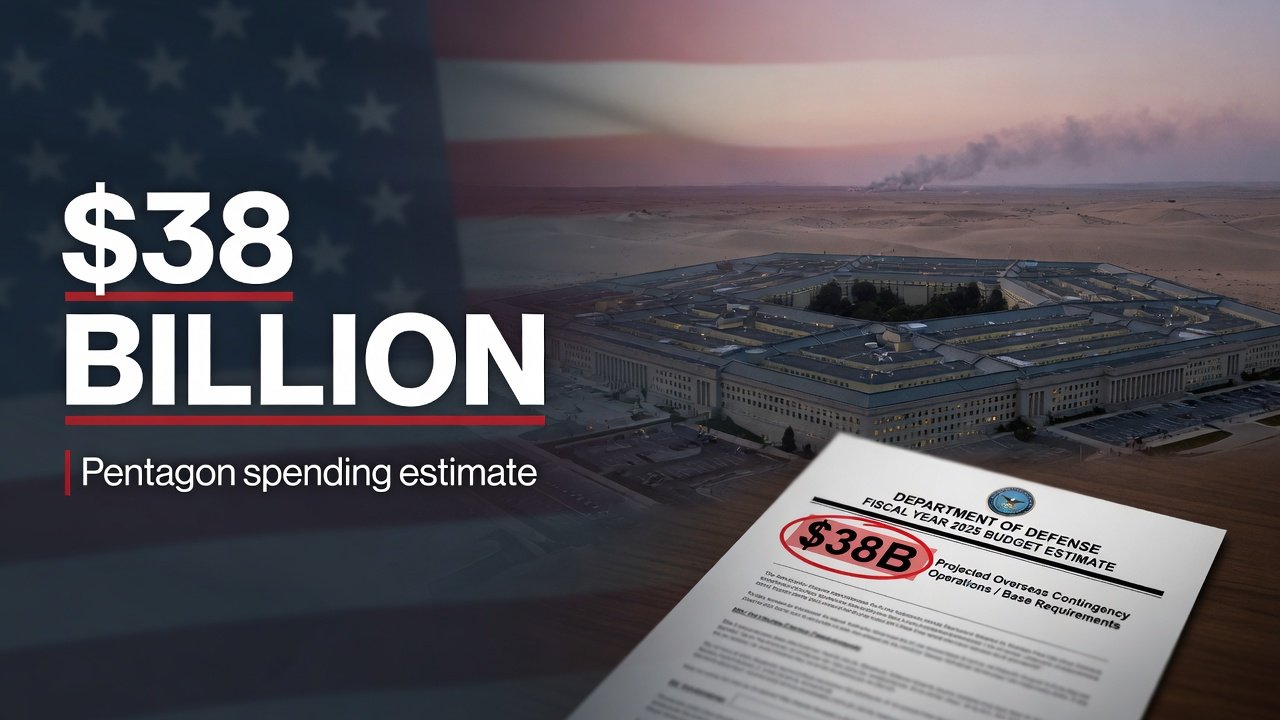
Cost of Iran Conflict: CBO Estimates Pentagon Spending Has Reached $38 Billion
The cost of Iran conflict has reached approximately $38 billion for the U.S. Department of Defense, according to a new estimate from the Congressional Budget Office (CBO). The assessment covers U.S. combat operations against Iran through August 1, 2026, and highlights the continuing financial and military-resource implications of the conflict.
The CBO released its report, Estimating the Cost of Combat Operations Against Iran, on September 15, 2026. The analysis examines not only direct Department of Defense expenses but also broader economic and budgetary effects associated with the conflict.
Importantly, the $38 billion figure represents the CBO’s estimate of the Department of Defense’s operational, logistical and sustainment costs. It is not a complete estimate of every federal or economic cost associated with the conflict.
CBO Estimates Pentagon Cost at $38 Billion
According to the Congressional Budget Office, the conflict had cost the Department of Defense approximately $38 billion as of August 1, 2026.
The estimate includes several categories of military spending, including the replacement of expended ammunition and equipment lost during combat, increased aircraft flying hours, other military operations and higher fuel expenses.
The CBO noted that its estimate reflects the relatively intense initial phase of the conflict, which lasted slightly more than a month, followed by lower-intensity combat operations that continued afterward.
The agency also emphasized that the $38 billion figure does not include every military expense connected to the conflict.
For example, normal operating costs that were already included in the federal budget are excluded, as are costs incurred by other federal agencies.
Monthly Cost Could Continue to Rise
One of the most significant findings in the CBO report is that the cost of Iran conflict could continue increasing as long as military operations remain underway.
The CBO estimates that if violence remained at the relatively low levels seen in May and June, another month of conflict could cost the Department of Defense about $2 billion.
If the intensity increased to approximately the level seen in July, the monthly cost could rise to around $3 billion. The agency also noted that monthly costs could be higher if the intensity of fighting increased further.
This means the $38 billion estimate should not be viewed as a final cost for the conflict. Continued operations would add to the total.
What Is Included in the $38 Billion?
The CBO’s estimate covers several direct costs associated with military operations.
These include:
- Replacement of expended munitions
- Replacement of equipment lost in combat
- Additional aircraft flying hours
- Operational expenses
- Increased fuel costs
- Other logistical and sustainment expenses
The estimate is specifically focused on the Department of Defense rather than the overall economic cost of the conflict.
This distinction is important because the broader financial consequences could extend beyond the Pentagon’s direct spending.
CBO Warns of Military Readiness Costs
Beyond direct spending, the CBO identified an important opportunity cost involving U.S. missile-defense capabilities.
The agency said the conflict has involved significant use of missile-defense interceptors. As a result, the United States could have a reduced inventory of those interceptors for several years.
According to the CBO, the reduced inventory could become particularly important if the United States later faced a conflict with an adversary possessing large numbers of ballistic and cruise missiles. The agency specifically referenced China’s missile arsenal in discussing this potential readiness issue.
The finding illustrates that the financial cost of a military conflict can extend beyond money spent during combat. Replenishing weapons and equipment can require additional procurement and production over subsequent years.
Pentagon Funding Request Was Higher Than CBO Estimate
The CBO report also compared its estimate with an emergency funding request made by the administration.
In June, the administration requested $87.6 billion in supplemental appropriations. Of that amount, $67.1 billion was requested for the Department of Defense.
The portion of the request that CBO considered directly related to the conflict was approximately $42.3 billion, which was around 10% higher than the CBO’s $38 billion estimate of Defense Department costs through August 1.
The difference reflects the fact that funding requests and estimates of costs can cover different periods, assumptions and requirements.
CBO Faced Data Limitations
The Congressional Budget Office also highlighted uncertainty surrounding its calculations.
The agency said the Department of Defense did not respond to its requests for information. Consequently, CBO relied on government databases and publicly available reports to estimate the costs.
Because of those limitations, the agency described its estimates as subject to considerable uncertainty.
That caveat is important when interpreting the $38 billion figure. It is an independent CBO estimate rather than a final accounting from the Pentagon.
Broader Economic Effects of the Iran Conflict
The CBO report goes beyond military spending and examines broader economic consequences.
One major concern identified by the agency is inflationary pressure resulting from disruptions to energy shipments.
The conflict has affected oil and natural-gas shipments through the Strait of Hormuz, while shipping disruptions in the Red Sea have also intensified. The CBO said these disruptions could contribute to higher energy prices and broader inflationary pressure.
Higher energy prices can affect households, transportation companies, manufacturers and other businesses by increasing operating and production costs.
The economic effects therefore extend beyond the federal government’s direct military expenditure.
Federal Budget Could Face Additional Pressure
As the conflict continues, additional military spending could place further pressure on the federal budget.
The direct cost of combat operations is only one component. Future expenses could also include replenishing weapons inventories, repairing damaged equipment and continuing military operations.
The CBO’s analysis also distinguishes between costs that have already occurred and potential future costs. Because the conflict remains ongoing, the ultimate financial impact cannot yet be determined.
The agency’s estimates therefore provide a snapshot of costs through August 1 rather than a final calculation of the war’s total cost.
How the Cost Could Change
The eventual cost of Iran conflict will depend heavily on the intensity and duration of military operations.
If combat remains limited, the additional monthly cost could stay closer to the CBO’s lower estimate of approximately $2 billion.
If fighting intensifies, monthly costs could move toward or beyond the $3 billion level identified by the CBO for conditions similar to July.
A longer conflict would also create additional logistical, equipment and weapons-replacement requirements.
Conflict Cost Compared With Earlier US Wars
The CBO noted that the current conflict has involved relatively fewer U.S. forces and has been shorter than major U.S. military operations in Iraq and Afghanistan.
The agency’s comparison is useful because it places the current spending estimate in a broader historical context. However, the $38 billion figure should not be directly treated as the total cost of the conflict because operations are still continuing and the CBO’s estimate covers only specific categories of expenses through August 1.
The eventual cost could therefore be substantially different depending on how the conflict develops.
What Happens Next?
The Pentagon’s financial requirements are likely to remain closely connected to developments on the battlefield.
The CBO estimates that continued low-intensity operations would add approximately $2 billion per month, while higher-intensity fighting could increase the monthly cost to roughly $3 billion or more.
Future developments that could influence spending include:
- The duration of military operations
- Changes in the intensity of fighting
- Use of additional military equipment
- Replacement of expended munitions
- Missile-defense requirements
- Fuel and logistics costs
- Additional emergency funding requests
The Pentagon’s future requirements could therefore change significantly depending on the trajectory of the conflict.
Looking Ahead
The latest CBO assessment puts the direct cost of Iran conflict for the Department of Defense at approximately $38 billion through August 1, 2026. The estimate includes operational, logistical and sustainment expenses but excludes several other federal and economic costs.
The CBO also estimates that continued operations could add billions of dollars each month, depending on the intensity of fighting. At the same time, the agency has highlighted potential longer-term effects involving missile-defense inventories, energy prices and inflation.
Because the conflict remains ongoing, the $38 billion figure should be viewed as a current estimate rather than the final financial cost. Further military operations, additional funding requirements and economic disruptions could increase the overall impact in the months ahead.
FAQs
1. What is the current cost of the Iran conflict?
The Congressional Budget Office estimates that the conflict had cost the Department of Defense approximately $38 billion as of August 1, 2026.
2. What does the $38 billion Pentagon cost include?
The estimate includes expenses such as replacing expended munitions and equipment, increased aircraft flying hours, military operations and higher fuel costs.
3. Is $38 billion the total cost of the Iran war?
No. The $38 billion figure covers specific Department of Defense costs through August 1. It does not represent every federal, economic or future cost associated with the conflict.
4. How much could the Pentagon spend each additional month?
The CBO estimates that another month could cost approximately $2 billion if violence remains at relatively low levels, or around $3 billion if fighting reaches an intensity similar to July.
5. Did the Pentagon provide all the information requested by CBO?
No. The CBO said the Department of Defense did not respond to its requests for information, so the agency relied on government databases and public reports.
6. Could the cost of the Iran conflict increase?
Yes. Because military operations are ongoing, the total cost is expected to increase as additional operations, fuel, equipment replacement and ammunition expenses are incurred.
7. What is the CBO?
The Congressional Budget Office is a federal agency that provides Congress with analysis of budgetary and economic issues, including estimates related to federal spending and defense programs.
8. Has the conflict affected US military readiness?
The CBO identified the use of missile-defense interceptors as an opportunity cost and said the United States could have a reduced inventory of interceptors for several years.
9. Has the Iran conflict affected energy prices?
The CBO identified disruptions to oil and natural-gas shipments through the Strait of Hormuz, along with Red Sea shipping disruptions, as sources of inflationary pressure.
10. When was the CBO’s Iran conflict cost report released?
The Congressional Budget Office released its report, Estimating the Cost of Combat Operations Against Iran, on September 15, 2026.