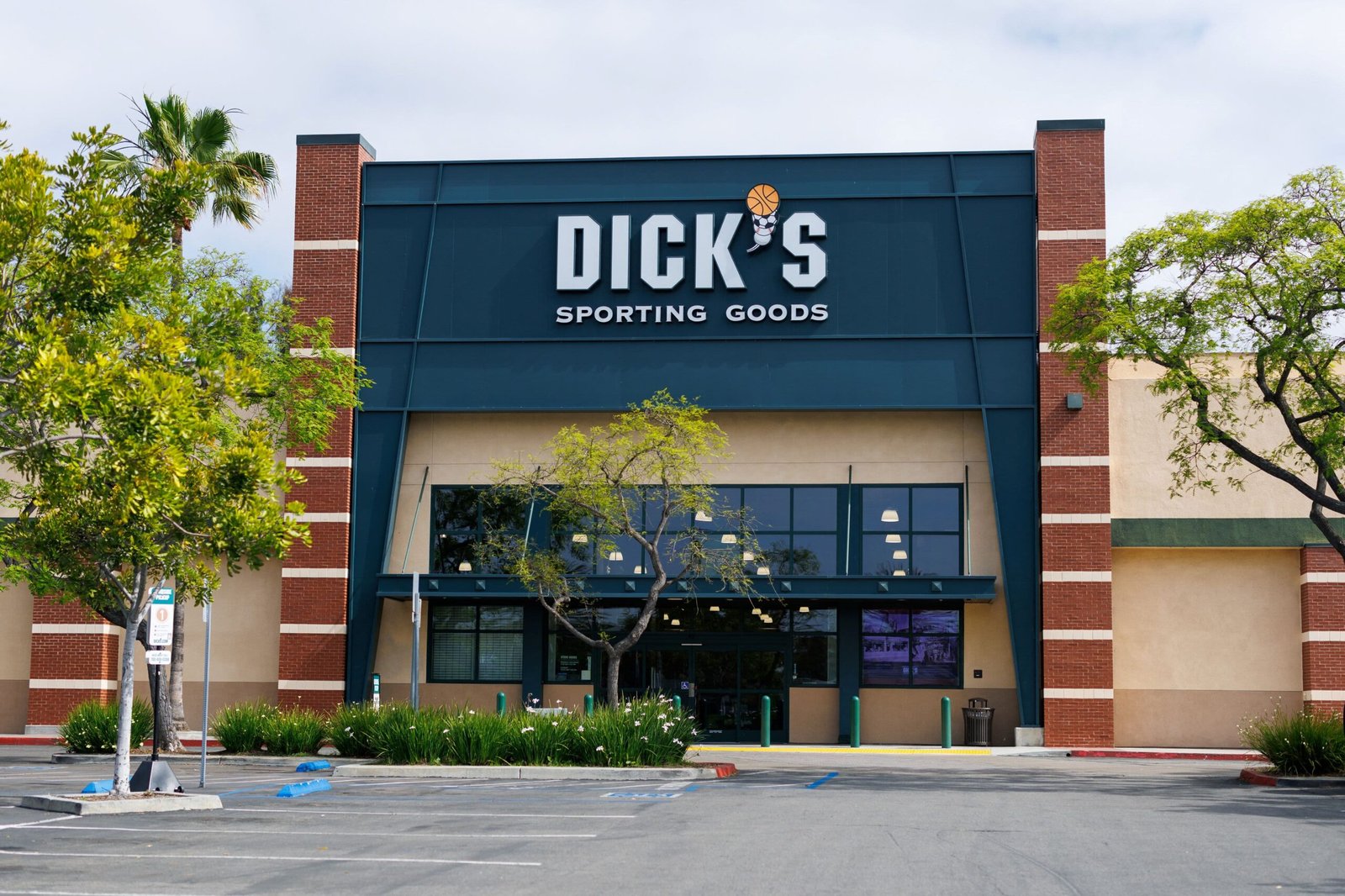
Retail Headwinds: Dick’s Sporting Goods Shares Plunge as Athleticwear Demand Weakens
Retail Headwinds have intensified in the US as Dick’s Sporting Goods shares plunged sharply after the retailer warned about weaker consumer demand for athletic footwear and apparel.
The company’s latest quarterly results fell short of Wall Street expectations, while management also reduced its full-year outlook. The disappointing update raised concerns about changing consumer preferences, excess inventory and increasing promotional activity across the athleticwear market.
Retail Headwinds Hit Dick’s Sporting Goods
The latest Retail Headwinds have put significant pressure on Dick’s Sporting Goods.
Shares of the retailer fell more than 27% following its quarterly update, with reports indicating the stock eventually recorded a decline of more than 30% during the sell-off. The sharp reaction reflected investor concerns over weaker demand and the company’s revised outlook.
The decline highlights the challenges facing retailers as consumers become more selective about discretionary purchases.
Weak Athleticwear Demand Raises Concerns
Dick’s Sporting Goods warned that demand for athletic apparel and footwear has weakened.
The company has been dealing with a more promotional retail environment, with brands and retailers offering greater discounts to attract customers.
This trend can put pressure on margins while also making it harder for retailers to maintain full-price sales.
For Dick’s, the weakness has been particularly noticeable in the footwear category.
Foot Locker Adds to the Pressure
A major factor behind the latest concerns is Foot Locker, which Dick’s Sporting Goods acquired for approximately $2.4 billion in 2025.
Foot Locker’s performance has been weaker than expected, with comparable sales declining during the quarter. The business has also been affected by weaker demand for older footwear styles and disappointing product launches.
Because footwear represents a major part of Foot Locker’s business, weakness in the sneaker market has had a significant impact on Dick’s overall outlook.
Consumers Become More Cautious
Another important factor behind the Retail Headwinds is changing consumer behavior.
Dick’s management indicated that consumers have become more cautious, particularly amid broader economic and geopolitical uncertainty.
When consumers become more selective, they may delay purchases or wait for discounts before buying discretionary products such as athletic shoes and apparel.
This can create additional pressure for retailers that depend on full-price sales.
Excess Inventory Becomes a Challenge
The athletic footwear market is also facing inventory-related problems.
Industry executives have pointed to elevated inventory levels, particularly involving older footwear styles.
When retailers have too much inventory, they may need to offer discounts to clear products.
While discounts can help move merchandise, they can also reduce profitability and make it more difficult for retailers to achieve their original earnings targets.
Promotional Activity Intensifies
The retail market has become increasingly promotional as companies compete for cautious shoppers.
Greater discounting by brands can spill over into physical and online retail channels.
For consumers, this can create attractive deals. For retailers, however, it can make maintaining margins more difficult.
Dick’s has also increased promotional activity as it attempts to remain competitive in the changing athleticwear environment.
Dick’s Cuts Its 2026 Outlook
The company responded to the challenging environment by lowering its full-year expectations.
Dick’s now expects annual sales of approximately $21.9 billion to $22.2 billion, compared with its previous forecast of $22.1 billion to $22.4 billion.
The retailer also reduced its expected adjusted earnings per share to approximately $11 to $12.
Its operating income outlook was lowered to between $1.45 billion and $1.55 billion, down from the previous range of $1.68 billion to $1.81 billion.
Core Dick’s Business Shows Strength
Despite the broader problems, Dick’s core business has not been uniformly weak.
The company’s traditional Dick’s operations recorded comparable sales growth during the quarter, showing that some parts of the business remain relatively resilient.
However, weakness at Foot Locker and challenges across athletic footwear have overshadowed those positive developments.
This has made the company’s overall outlook more difficult for investors to assess.
Impact on Other Sportswear Stocks
The sell-off in Dick’s Sporting Goods also affected other companies in the athleticwear and footwear industry.
Shares of major sportswear brands, including Nike, Adidas, Puma and On Holding, came under pressure as investors reassessed the strength of consumer demand and the broader footwear market.
The market reaction suggests that investors are concerned the problems may extend beyond a single retailer.
Why This Matters for the Retail Sector
The situation at Dick’s Sporting Goods provides another indication of the challenges facing discretionary retailers.
Consumers are still spending, but their purchasing decisions are becoming more selective.
Retailers that depend heavily on fashion trends, product launches and discretionary spending can be particularly vulnerable when shoppers become cautious.
The increasing use of promotions also creates additional pressure on profitability.
Athletic Footwear Market Faces a Reset
The latest developments point toward a potential reset in the athletic footwear market.
Some established sneaker styles have lost momentum, while newer product launches have not generated the expected level of demand.
This creates a difficult environment for retailers carrying large inventories of older products.
Brands may need to introduce more compelling products and retailers may need to adjust their merchandise strategies to respond to changing consumer preferences.
What Investors Are Watching
Investors will now be closely monitoring Dick’s ability to improve the performance of Foot Locker and manage inventory levels.
Future earnings reports will provide more information about whether the current weakness is temporary or part of a longer-term shift in consumer behavior.
The performance of the wider athleticwear sector will also be important.
If demand improves and promotional activity declines, retailers could regain some pricing power. If weakness continues, further pressure on margins and earnings could follow.
Retail Headwinds: Key Takeaway
Retail Headwinds are becoming increasingly visible in the US athleticwear market as Dick’s Sporting Goods faces weaker consumer demand, excess inventory and greater promotional pressure.
The company’s shares plunged sharply after its latest earnings update, while management lowered its full-year outlook. The newly acquired Foot Locker business has been a major source of weakness, particularly because of challenges in the footwear market.
The situation highlights a broader shift in consumer behavior, with shoppers becoming more selective and retailers competing more aggressively through discounts.
For investors, the key question now is whether the weakness represents a temporary adjustment in the sportswear market or a longer-lasting change in consumer demand.
Frequently Asked Questions (FAQs)
1. What are the Retail Headwinds facing Dick’s Sporting Goods?
Dick’s is facing weaker athleticwear demand, excess inventory, increased discounting and challenges within its Foot Locker business.
2. Why did Dick’s Sporting Goods shares plunge?
The shares fell sharply after the company reported disappointing quarterly results and lowered its full-year outlook amid weaker athletic footwear demand.
3. What is causing weakness in athleticwear demand?
Consumers have become more cautious, while certain older footwear styles and recent product launches have failed to generate expected demand.
4. How is Foot Locker affecting Dick’s Sporting Goods?
Foot Locker has struggled with weaker comparable sales and challenges in its core footwear business, weighing on Dick’s overall results.
5. Did Dick’s lower its 2026 guidance?
Yes. The company reduced its forecasts for sales, operating income and adjusted earnings per share.
6. Is the entire sportswear industry facing pressure?
Several athleticwear and footwear companies have faced investor concerns as demand weakens and promotional activity increases.
7. Why is excess inventory a problem for retailers?
High inventory levels can force retailers to offer discounts, which can increase sales but reduce profit margins.
8. Are consumers completely stopping their spending?
Not necessarily. The current trend is more about consumers becoming selective, delaying purchases and responding more strongly to discounts.
9. What will investors watch next?
Investors will monitor consumer demand, Foot Locker’s performance, inventory levels, promotional activity and Dick’s future earnings guidance.
10. What does the situation mean for the retail sector?
It highlights continuing Retail Headwinds as retailers deal with cautious consumers, changing product preferences and increased competition on pricing.