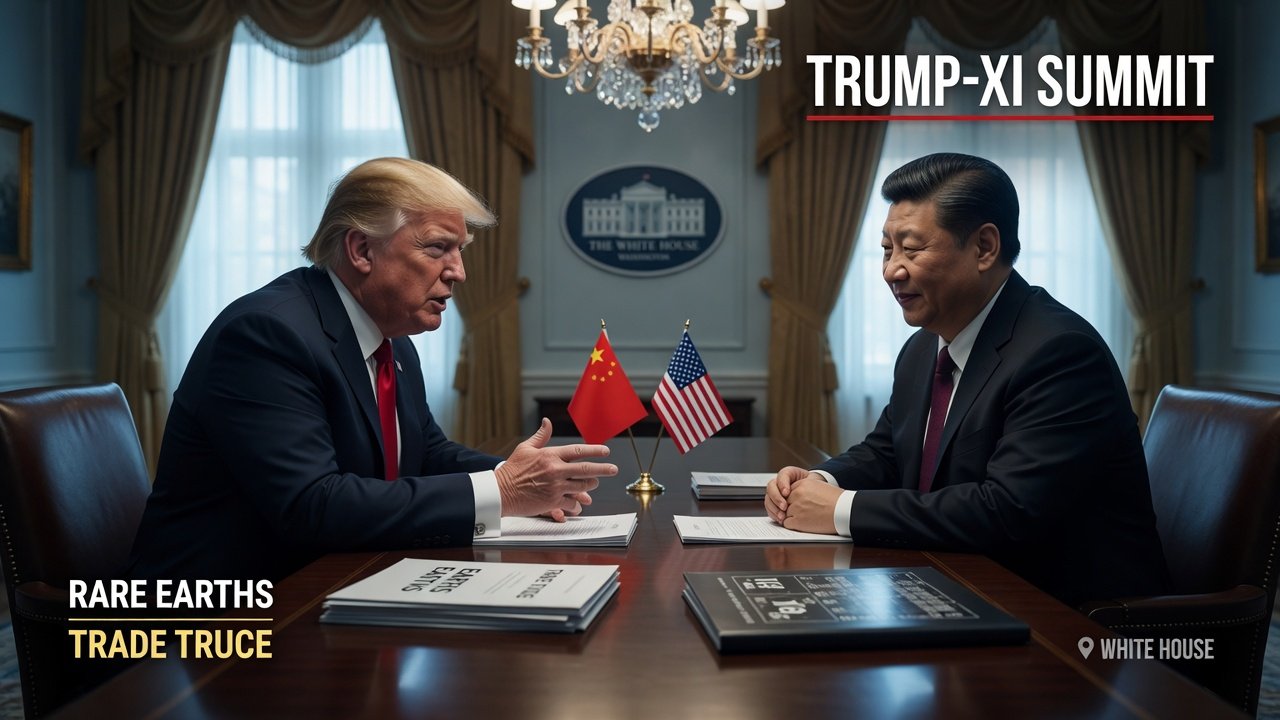
Trump-Xi Summit: Rare Earths and Trade Truce Take Center Stage at White House
US President Donald Trump is hosting Chinese President Xi Jinping at the White House on September 24, 2026, for a closely watched summit focused on trade, technology, critical minerals and broader US-China relations.
Xi arrived in Washington on September 23 for a three-day state visit, marking his first trip to the United States in more than a decade. The meeting comes after Washington and Beijing agreed to extend their existing trade truce by another two months, moving the current deadline to January 10, 2027.
Trump-Xi Summit Comes After Trade Truce Extension
The summit follows several rounds of negotiations between US Treasury Secretary Scott Bessent, US Trade Representative Jamieson Greer and Chinese Vice Premier He Lifeng.
Bessent said the two countries had agreed to extend the trade truce by two months, giving negotiators additional time to work toward a broader economic agreement. The previous arrangement had been scheduled to expire on November 10.
The extension does not resolve the wider trade relationship. Tariffs and other restrictions remain, while Washington and Beijing continue discussions over areas including agricultural purchases, rare earth supplies and technology.
Rare Earth Minerals Become a Major Negotiating Issue
One of the most important issues at the Trump-Xi summit is China’s control over rare earth minerals and related processing capacity.
Rare earth elements are critical inputs for numerous high-tech and industrial products, including electronics, electric vehicles, advanced manufacturing equipment and defense technologies.
Reuters reported that China controls a substantial share of global rare-earth mining, refining and magnet production. The issue became particularly sensitive after Beijing restricted rare-earth exports during an earlier escalation in the US-China trade conflict.
Washington is seeking greater access to rare earths and critical minerals, while Beijing has its own demands involving US technology restrictions.
US Wants More Predictable Rare Earth Supplies
The United States has been pressing China to ease restrictions affecting the supply of rare earths and critical minerals.
The issue has become strategically important because disruptions could affect American manufacturers that depend on Chinese-linked supply chains.
According to Reuters, US officials are also seeking progress on broader trade commitments, while China has been pressing Washington over restrictions on advanced technology exports.
The summit therefore brings together two interconnected issues: China’s position in critical-mineral supply chains and America’s control over advanced technologies.
Trade Truce Now Runs Until January 10
The latest agreement extends the current US-China trade truce until January 10, 2027.
The extension gives both governments additional time to negotiate a larger agreement rather than immediately returning to higher levels of trade confrontation.
Bessent said Washington and Beijing were discussing the possibility of a broader deal, although the exact scope and timing remained uncertain.
Agriculture Is Another Key Issue
Agricultural purchases are also expected to feature prominently in the discussions.
China has committed to purchasing US agricultural products under previous arrangements. Bessent said Beijing was meeting its soybean purchase requirement but was behind on its commitment to buy $17 billion of other US agricultural products.
US negotiators are therefore seeking greater clarity on agricultural commitments as part of the broader trade discussions.
Potential Tariff Changes on Non-Critical Goods
Another issue under discussion is the possibility of removing tariffs on approximately $30 billion of non-critical goods.
Bessent said potential announcements could also involve financial services and agricultural purchases. However, the precise terms of any agreement were still being negotiated ahead of the leaders’ meeting.
Any tariff adjustments would represent only one part of a much broader US-China economic relationship that continues to involve restrictions and competing strategic interests.
Artificial Intelligence Also on the Agenda
Artificial intelligence is another major issue surrounding the Trump-Xi summit.
US and Chinese officials have discussed establishing an AI safety communications channel to allow the two countries to notify each other about certain AI-related safety incidents.
However, substantial differences remain over technology development, export controls and strategic competition in advanced AI.
The two governments are simultaneously competing for leadership in advanced computing and AI while maintaining extensive economic links.
Taiwan Remains a Sensitive Issue
Taiwan is another major issue in the broader US-China relationship.
China claims Taiwan as part of its territory, while the United States maintains longstanding relations with Taiwan and provides support that Beijing strongly opposes.
Reuters reported that Taiwan was expected to be among the sensitive subjects surrounding the summit, although the focus of the meeting was also heavily centered on economic and trade matters.
Iran Adds Another Layer to the Talks
The US-China relationship is also being affected by developments involving Iran.
Reuters reported that China and the United States remain divided over China’s relationship with Iran, while Trump is dealing with the economic and geopolitical effects of the ongoing conflict.
The issue adds another foreign-policy dimension to the Trump-Xi discussions beyond trade and technology.
Xi’s White House Visit Marks a Major Diplomatic Event
The White House has prepared an extensive state visit program for Xi.
Trump and First Lady Melania Trump are hosting Xi and Chinese First Lady Peng Liyuan for an official state visit on September 24. The schedule includes a formal arrival ceremony, military honors and a state dinner at the White House.
Xi’s visit is his first to Washington in more than a decade, making the summit a significant diplomatic event even before the substance of the negotiations is considered.
Trump and Xi Seek Stability While Disagreements Continue
The summit takes place against a complicated economic backdrop.
Both countries have strong commercial ties but remain involved in disputes over tariffs, technology restrictions, critical minerals, Taiwan and other strategic matters.
Xi has called for the United States and China to act as partners rather than rivals, according to a statement released by the Chinese embassy before the talks.
At the same time, US officials continue to emphasize issues such as reciprocity, market access and national security.
What Could Come Out of the Trump-Xi Summit?
Potential areas for announcements include agricultural purchases, tariff adjustments on selected goods, financial services, rare-earth supplies and further discussions on AI.
However, officials have not indicated that a comprehensive US-China trade agreement is guaranteed during the meeting.
The two-month extension of the trade truce provides additional time for negotiations, with the next major deadline now set for January 10, 2027.
Why Rare Earths Matter to the Global Economy
Rare earth minerals have become an increasingly important part of global economic and national-security discussions.
Their applications range from consumer electronics and industrial equipment to electric vehicles and defense systems. China’s dominant position in mining, refining and magnet manufacturing gives Beijing significant influence over parts of the global supply chain.
For the United States, securing reliable access to critical minerals is therefore linked to both industrial supply chains and technology policy.
Frequently Asked Questions
1. When is the Trump-Xi summit?
US President Donald Trump and Chinese President Xi Jinping are scheduled to meet at the White House on September 24, 2026.
2. Why is the Trump-Xi summit important?
The meeting brings together discussions on US-China trade, tariffs, rare earth minerals, artificial intelligence, agriculture, Taiwan and other strategic issues.
3. How long has Xi been away from the White House?
Xi’s September 2026 visit marks his first trip to Washington in more than a decade.
4. What happened to the US-China trade truce?
The United States and China agreed to extend their existing trade truce by two months, moving its current expiration date to January 10, 2027.
5. Why are rare earth minerals important?
Rare earths are used in a wide range of high-tech and industrial applications, including electronics, electric vehicles, advanced equipment and defense technologies.
6. What does the US want from China on rare earths?
Washington is seeking more reliable access to rare earth minerals and critical-mineral supplies and has raised concerns about Chinese export restrictions.
7. Are tariffs being discussed at the summit?
Yes. The two countries are discussing tariff-related issues, including the possibility of removing tariffs on around $30 billion of non-critical goods.
8. Is AI part of the Trump-Xi discussions?
Yes. US and Chinese officials have discussed AI-related cooperation and a potential communications mechanism for AI safety incidents, although major differences over technology remain.
9. What other issues are on the agenda?
Agricultural purchases, financial services, Taiwan, Iran, technology restrictions and broader trade relations are among the issues surrounding the summit.
10. When does the extended US-China trade truce expire?
The current two-month extension takes the trade truce through January 10, 2027, although officials have indicated that further negotiations could continue beyond that date.