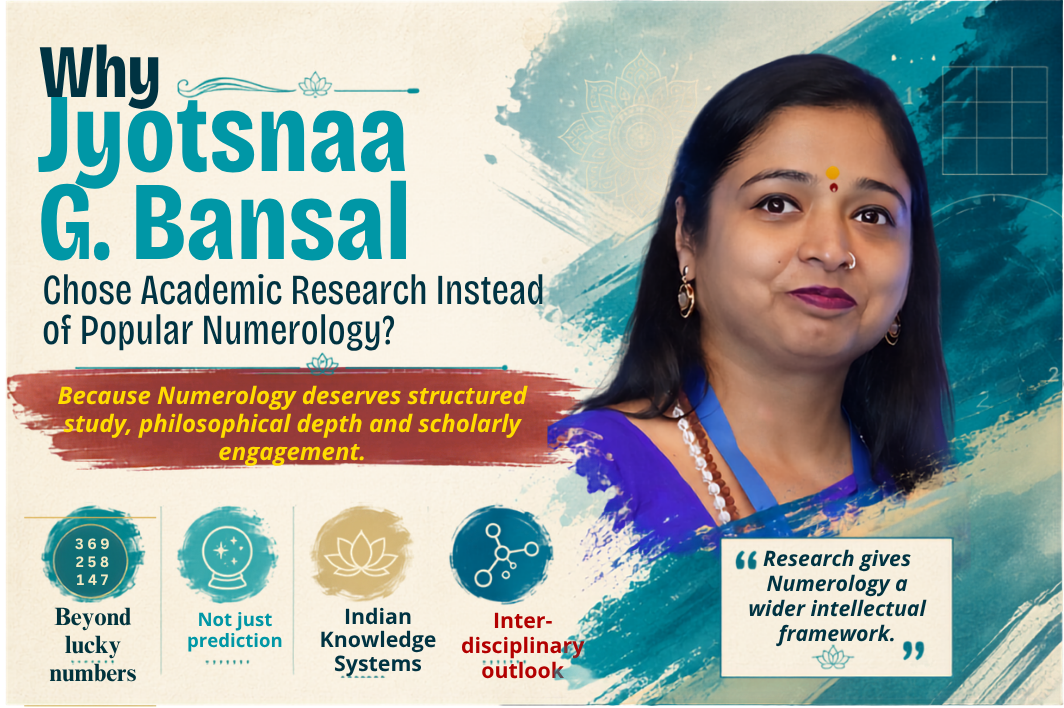
For many numerologists, public consultations, books, and workshops become the main way to share their work. Jyotsnaa G. Bansal chose a different direction. Rather than limiting her work to public practice, she decided to study numerology through academic research and place her findings before scholars, researchers, and educational institutions.
That decision shaped the next stage of her career and led to a series of research papers, conference presentations, and academic publications.
Why She Wanted Scholarly Discussion
Jyotsnaa’s interest in numerology grew alongside her study of various subjects in Indian Knowledge Systems. She wanted to study Numerology through research instead of relying only on traditional practice.
Jyotsnaa has achieved a meaningful academic & research milestone in Numerology. Her latest research paper has been published in Prajnā, a reputed research journal of Poornaprajna Samshodhana Mandiram, Bengaluru. The institute is recognised as an “Adarsha Shodha Samsthan” by Central Sanskrit University, New Delhi. Through this work, which studies the relationship between Indian philosophy and Numerology, she has brought numerology into an academic setting where ideas are presented, discussed, and recorded through research publications.
This publication is an important step because it brings Numerology into a more serious academic discussion. Usually, Numerology is seen only as a belief-based or prediction-related practice. However, this research looks at it from a wider and more scholarly point of view. It shows that Numerology need not be seen as a separate or vague subject.
The publication also gives Numerology a place within structured academic research through a recognized platform. By connecting Numerological ideas with the core concepts of IKS and Philosophical studies, the research opens new possibilities for further study, discussion and interdisciplinary exploration.
Publication Began Long Before the Journal
Publishing in an academic journal is only one part of the process. Before reaching this stage, Jyotsnaa spent years presenting research papers at national and international conferences.
Her work has covered Indian Knowledge Systems, Puranas, Ayurveda, the Chakra system, and Numerology. She has presented her research at prestigious institutions such as St. Stephen’s College, Central Sanskrit University, and Shri Lal Bahadur Shastri National Sanskrit University. Each paper became another step in building her academic work.
One of her earlier papers on Ayurvedic Numerology was selected among the first ten papers at a University of Delhi conference. The conference souvenir carrying the paper was released by the then Hon’ble Education Minister, Shri Dharmendra Pradhan. The research later received wider attention through Panchjanya on National Ayurveda Day 2025.
Taking Knowledge to Different Readers
Jyotsnaa’s work is not limited to research papers. She writes for The Daily Guardian and Panchjanya, where she shares articles on Indian philosophy, spirituality, Sanskrit, Numerology, and Indian Knowledge Systems. She is also the Managing Editor of ASMITAA, an International peer-reviewed academic magazine that publishes articles from our scriptures in these fields, in simple language for the common reader to understand easily.
She is also the author of Hypothyroidism Healed: Combined Holistic Approach – Yoga, Reiki, Mantra & Crystals, a book based on her personal healing experience. Through both academic and public writing, she reaches different groups of readers while keeping research at the centre of her work.
Research With a Long-Term Vision
Jyotsnaa’s academic work has received recognition over the years. In 2026, she received the Arundhati – International Vidushi Pratibha Samman at the University of Lucknow by Global Sanskrit Forum for her contribution to research, literature, and Indian knowledge traditions. She is also recognised as India’s First Female Numerologist to publish Numerology-based research papers in an international journal.
For Jyotsnaa, academic research is more than a personal achievement. It is a way to encourage serious study of Numerology in correlation with traditional Indian knowledge and leave behind published work that future scholars can read, discuss, and build upon.