Sometimes an idea begins long before you realize you are building something.
For me, EQPitch grew from a question that connected two parts of my journey that, at first, seemed quite different: psychology and artificial intelligence. With my background in psychology and my current studies in business and AI, I kept thinking about what happens to human skills as technology becomes increasingly capable. AI can help us write, analyze, brainstorm, and work faster, but people still need to communicate, understand emotions, manage conflict, exercise judgment, and lead.
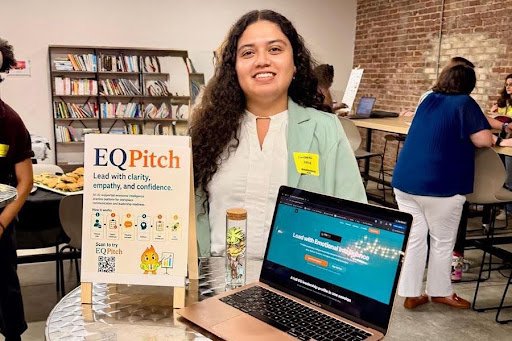
That thinking eventually became the starting point for EQPitch, an AI-supported platform designed to help people practice emotional intelligence through realistic workplace situations. But having an idea and building something people can actually use are two very different things. Unlock Alabama became the place where I started learning that difference.
I joined the eight-week Unlock Alabama program with an early-stage idea and many questions. Like many first-time builders, my instinct was initially to think about everything the platform could become. The program continuously brought me back to something much more fundamental: What problem are you solving? Who experiences this problem? Would they actually use your solution?
Instead of trying to build everything at once, I started with a simple first version containing 15 emotional-intelligence scenarios. The purpose was not to prove that I had built the perfect product. It was to put something in front of people and learn from how they experienced it. Users told me what worked, but more importantly, they told me what did not. They wanted clearer explanations of results, more scenarios, practical activities, and a better understanding of what their scores meant.
Week by week, EQPitch evolved. The platform expanded from 15 scenarios to 50, adding reflection prompts, post-scenario insights, practical activities, and skill-based results. Among early users who provided feedback, 90 percent described the scenarios as realistic and 80 percent said they would use the platform again. I began to understand that feedback was not a judgment of whether my idea was good or bad; it was information that could make the next version better.
But Unlock Alabama was not only about building the product. It taught me how much exists around the product. I was learning customer discovery and how to talk about the problem before talking about the solution. I worked through financial activities that pushed me to think about how an idea could eventually become sustainable. I learned about pitching, positioning, storytelling, and communicating the value of something I had spent months thinking about.
One of the biggest learning experiences was building in public. I had to become comfortable sharing an unfinished idea, asking people to test it, hearing criticism, talking about weekly progress, and showing what I had changed because of what I learned. For someone coming primarily from an academic and clinical background, this was a different way of working. Research often encourages us to refine before presenting; entrepreneurship repeatedly asked me to present, learn, refine, and present again.
Even creating the pitch deck and demo video became part of that learning. I had to explain EQPitch without relying on everything I knew about the psychology behind it. What was the problem? Why did it matter now? Who was it for? Could someone understand the idea in a few minutes? Those exercises taught me that building something and communicating why it should exist are two different skills.
By the end of the eight weeks, those pieces came together at the main event. I was able to demonstrate EQPitch, participate in a panel, speak about the journey, and meet people who could interact with what I had been building. What had started as an idea was now something I could put in another person’s hands and ask, “What do you think?”
Perhaps the most valuable thing Unlock Alabama gave me was not an answer about exactly what EQPitch should become. It gave me a platform to experiment with the question and a community in which I could learn how to build around it.
Building something for the first time requires becoming comfortable with not knowing everything at the beginning. Product development, customer feedback, marketing, financial thinking, pitching, and storytelling may look like separate activities, but I learned that they are all different ways of answering the same question: Does what I am building create enough value for someone else to care about it?
As a mental health professional, I have always believed that growth involves reflection, feedback, and practice. Building EQPitch made me experience that principle from the other side. In some ways, the journey of creating EQPitch has reflected the philosophy behind the platform itself: you do not develop simply by knowing what to do. You develop by trying, reflecting, adapting, and trying again.