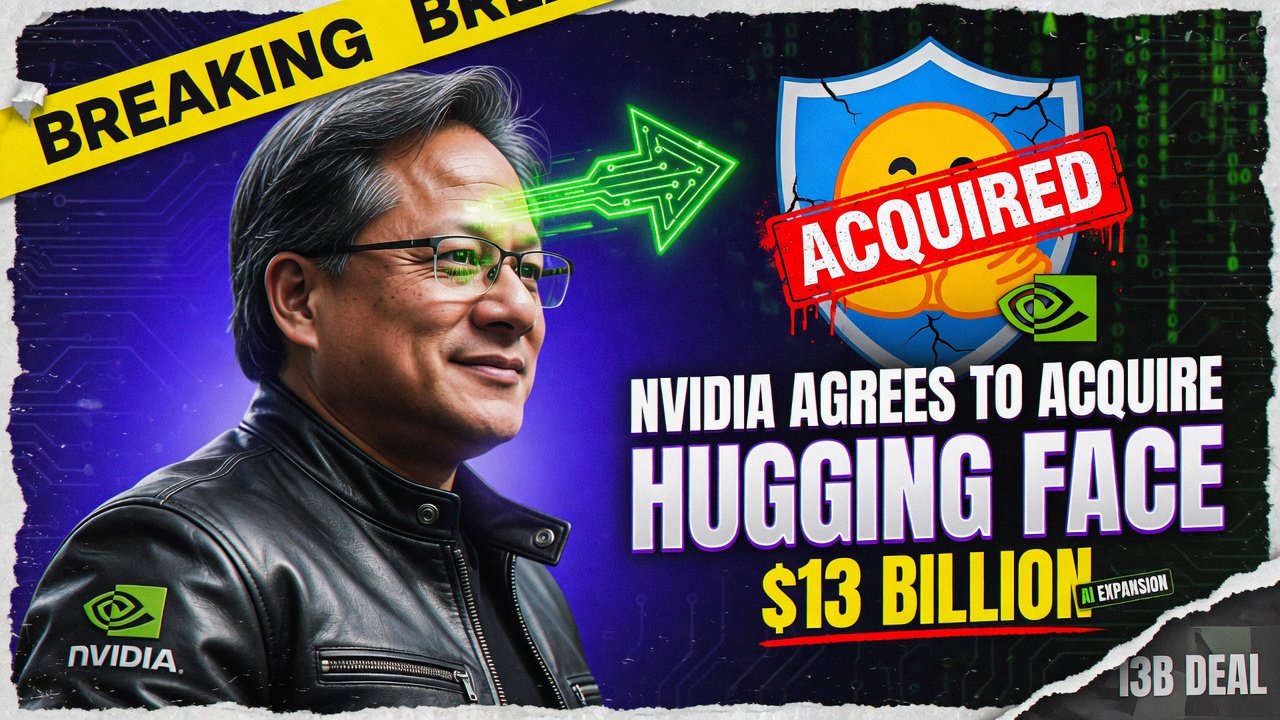
Nvidia Agrees to Acquire Hugging Face for Nearly $13 Billion in AI Expansion
Nvidia Hugging Face Acquisition is set to mark a major expansion of Nvidia’s influence across the artificial intelligence industry, with the chip giant reportedly agreeing to acquire open-source AI platform Hugging Face for nearly $13 billion.
The proposed deal would move Nvidia deeper into the software and developer side of artificial intelligence, extending its position beyond graphics processors and AI accelerators into models, development tools and AI infrastructure.
Hugging Face has become one of the most important platforms in the open-source AI ecosystem, providing developers and researchers with access to thousands of machine-learning models, datasets and development tools.
Nvidia Looks Beyond AI Chips
Nvidia has built its dominance in artificial intelligence largely through its high-performance GPUs and related computing infrastructure.
The company’s hardware has become a critical component of AI data centers powering large language models, generative AI applications and advanced computing workloads.
However, the competitive AI landscape is increasingly shifting beyond hardware.
Companies are now competing across the entire AI technology stack, including chips, cloud infrastructure, models, developer platforms and applications.
The potential acquisition of Hugging Face would give Nvidia a stronger position in one of those increasingly important layers.
Why Hugging Face Matters
Hugging Face has developed into a major hub for open-source artificial intelligence.
Its platform allows developers and researchers to discover, share and work with machine-learning models and datasets.
The company has helped make AI development more accessible by providing tools that allow developers to experiment with models without having to build every component from scratch.
Its community includes researchers, startups, developers and major technology companies.
That broad developer ecosystem is one of the most strategically valuable parts of the platform.
Nvidia Could Gain a Powerful Developer Ecosystem
The Nvidia Hugging Face Acquisition could give Nvidia direct access to a large community of AI developers.
Nvidia already provides software libraries and development tools designed to make its hardware more useful for AI workloads.
Integrating or closely connecting those capabilities with Hugging Face could potentially make Nvidia’s technology more attractive to developers building AI applications.
The move could also help Nvidia understand what developers need as AI models become increasingly sophisticated.
From Chips to the Full AI Stack
The potential transaction reflects Nvidia’s broader strategy of building an ecosystem around artificial intelligence rather than simply selling chips.
Nvidia has invested heavily in networking, data-center systems, software and AI development platforms.
Hugging Face would add another important component: an established open-source community and model ecosystem.
Together, these capabilities could strengthen Nvidia’s position across multiple layers of the AI stack.
Open-Source AI Becomes More Important
The rise of open-source AI has changed the competitive landscape.
While companies such as OpenAI, Google and Anthropic have developed proprietary AI systems, open-source and openly available models have attracted developers seeking flexibility and lower barriers to experimentation.
Hugging Face has played a central role in this movement.
Its platform has become a place where researchers and developers can publish models, datasets and tools and collaborate with other members of the AI community.
For Nvidia, gaining a stronger position in this ecosystem could provide strategic advantages as open AI models continue to evolve.
Potential Benefits for AI Developers
An Nvidia acquisition could potentially provide Hugging Face with greater access to computing resources and Nvidia’s AI infrastructure.
Training and deploying advanced AI models requires enormous amounts of computing power.
Nvidia’s GPUs and data-center technology already underpin much of the industry’s AI infrastructure.
Closer integration between Nvidia’s hardware and Hugging Face’s developer platform could potentially make it easier for developers to train, fine-tune and deploy models.
Competition in AI Infrastructure
The deal would also strengthen Nvidia’s position against competitors attempting to challenge its dominance.
Companies including AMD, Google and other technology providers are developing competing AI accelerators and infrastructure.
At the same time, cloud providers are increasingly building their own AI hardware and software ecosystems.
By expanding into developer tools and model platforms, Nvidia could make its ecosystem more difficult for customers and developers to move away from.
What the Deal Could Mean for Hugging Face
For Hugging Face, a transaction of nearly $13 billion would represent a major valuation milestone.
The company has grown from a startup focused on natural-language processing into a broad AI platform serving developers across machine learning.
An acquisition by Nvidia could provide significant financial and technological resources for further expansion.
The major question, however, would be how Nvidia manages Hugging Face’s open-source culture and developer community after the acquisition.
Concerns Around Open-Source Independence
The potential acquisition could also raise questions within the open-source AI community.
Hugging Face’s appeal is closely connected to its role as a relatively open platform for AI models and development tools.
Some developers could be concerned that ownership by a major chip manufacturer might influence platform policies or priorities.
Maintaining trust within the developer community could therefore become an important issue if the transaction moves forward.
Nvidia’s AI Dominance Could Expand Further
Nvidia already occupies a central position in the AI computing market.
Its GPUs are widely used to train and run large AI models, while its software ecosystem helps developers optimize AI workloads.
Adding Hugging Face would potentially allow Nvidia to reach developers at an earlier stage of the AI development process.
Instead of only providing the computing infrastructure required to run AI systems, Nvidia could become more deeply involved in the tools developers use to create them.
Impact on AI Startups
The acquisition could also influence AI startups.
Many smaller AI companies rely on open-source models and Hugging Face tools during the early stages of product development.
If Nvidia integrates Hugging Face more closely with its own ecosystem, startups could potentially gain access to more powerful development and computing capabilities.
At the same time, startups may watch carefully to ensure that the platform remains open and accessible across competing hardware environments.
Possible Regulatory Questions
A deal of this size involving two important players in the AI ecosystem could attract regulatory attention.
Nvidia already holds a powerful position in AI computing hardware, while Hugging Face has significant influence within the open-source AI developer community.
Regulators could examine whether the acquisition would reduce competition or give Nvidia excessive control over important parts of the AI technology stack.
The regulatory response could become an important factor in determining how quickly the transaction progresses.
The AI Industry Is Becoming More Integrated
The potential acquisition reflects a larger trend in the technology industry.
AI companies are increasingly trying to control multiple parts of the technology stack rather than specializing in a single layer.
Hardware companies are developing software platforms, cloud providers are building AI chips, and model developers are creating their own infrastructure.
Nvidia’s interest in Hugging Face would fit directly into this broader movement.
What Happens Next?
The next stage will depend on the formal terms of the transaction, regulatory review and the companies’ plans for integrating their respective technologies.
Investors and developers will also be watching closely for information about Hugging Face’s open-source projects and whether they will remain independently accessible.
If completed, the transaction could become one of the most significant AI acquisitions of the year.
Key Takeaway
The Nvidia Hugging Face Acquisition would represent a major strategic expansion for Nvidia, taking the company further beyond AI chips and into the developer tools, models and open-source AI ecosystem.
Hugging Face brings a large community of AI researchers and developers, while Nvidia brings leading AI computing hardware and infrastructure.
The combination could strengthen Nvidia’s position across the AI technology stack, although questions around open-source independence, competition and regulatory scrutiny are likely to remain important.
FAQs
1. What is the Nvidia Hugging Face Acquisition?
The reported deal involves Nvidia acquiring Hugging Face for nearly $13 billion, expanding Nvidia’s presence into AI software, developer tools and the open-source AI ecosystem.
2. What is Hugging Face?
Hugging Face is an AI platform that provides developers and researchers with access to machine-learning models, datasets and tools for building artificial intelligence applications.
3. Why does Nvidia want Hugging Face?
The acquisition could help Nvidia expand beyond AI hardware and gain a stronger position in AI models, developer tools and open-source software.
4. How much is Nvidia reportedly paying for Hugging Face?
The reported value of the acquisition is nearly $13 billion.
5. How could the deal benefit AI developers?
Closer integration between Hugging Face and Nvidia’s computing infrastructure could potentially make it easier for developers to train, fine-tune and deploy AI models.
6. Could the acquisition affect open-source AI?
Potentially. Hugging Face has a strong open-source community, so developers will likely pay close attention to how Nvidia manages the platform and its policies.
7. Does Nvidia already have AI software?
Yes. Nvidia has developed a broad software ecosystem alongside its AI chips and data-center infrastructure.
8. Could regulators review the deal?
A transaction involving major companies in important AI markets could attract regulatory scrutiny, particularly around competition and control of technology infrastructure.
9. What would the acquisition mean for Nvidia?
It could strengthen Nvidia’s position across more parts of the AI technology stack, from computing hardware to developer platforms and AI models.
10. Why is the deal important for the AI industry?
The potential acquisition highlights how competition in artificial intelligence is expanding beyond chips and models toward control of the broader ecosystem used to develop and deploy AI.