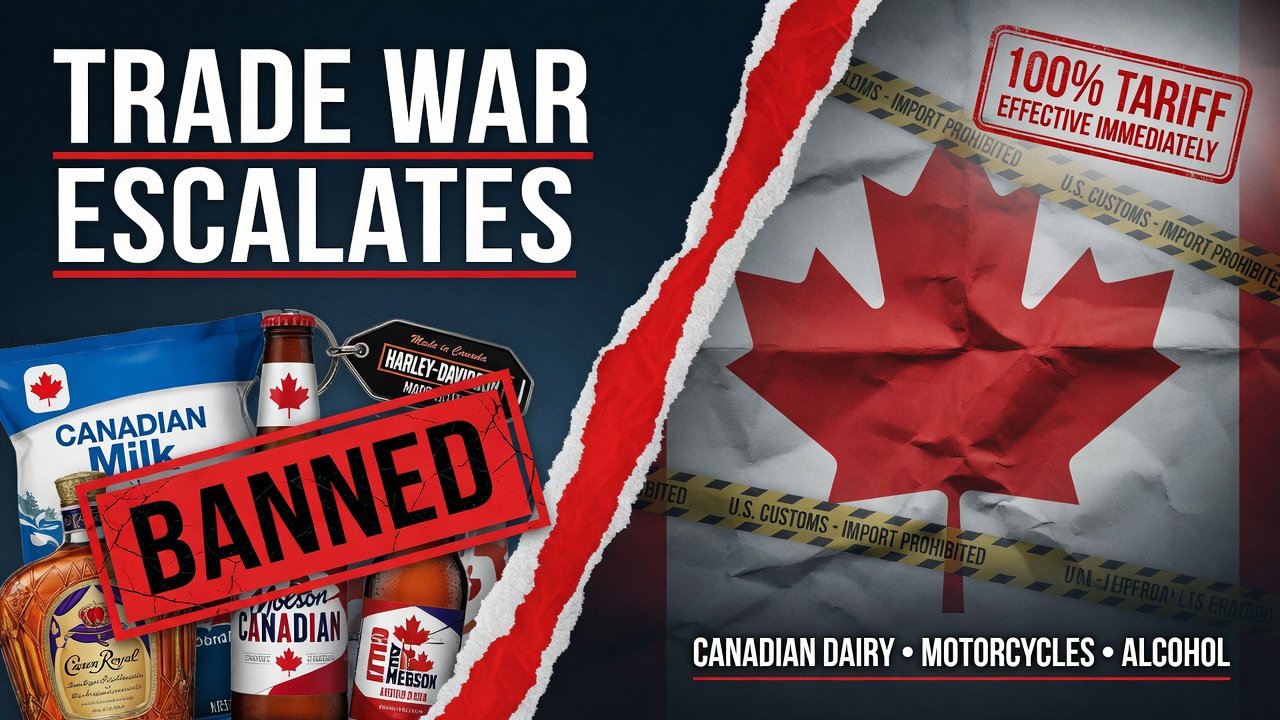
Canada Trade War Escalates as US Targets Key Canadian Imports
The Canada Trade War Escalates as the United States introduces new restrictions targeting imports from Canada, including dairy products, motorcycles and certain alcohol products.
The latest measures add another layer to an already complicated trade dispute between the two North American neighbours. Businesses on both sides of the border are now facing greater uncertainty over tariffs, import restrictions, supply chains and the future direction of bilateral trade.
Canada Trade War Escalates With New Import Restrictions
The latest US measures target selected Canadian products and represent a significant escalation in trade tensions.
Canadian dairy products, motorcycles and certain alcoholic beverages are among the products affected by the restrictions.
The move comes after months of disagreements between Washington and Ottawa over trade policy, tariffs and market access.
For companies that depend on cross-border commerce, the new restrictions could create additional costs and logistical complications.
Why Is the US Targeting Canadian Goods?
The latest restrictions are part of a wider dispute involving trade barriers and market access between the United States and Canada.
US officials have argued that certain Canadian trade practices create disadvantages for American businesses.
Canada, meanwhile, has defended its own trade policies and has previously responded to US measures with retaliatory tariffs.
The ongoing exchange has increasingly affected businesses that previously relied on relatively predictable cross-border trade.
Canadian Dairy Sector Faces New Pressure
Canada’s dairy industry has long been a sensitive issue in US-Canada trade relations.
Canada operates a supply-management system for dairy products, which includes controls on production, pricing and imports.
US dairy producers have frequently criticised Canada’s market-access rules, arguing that they restrict American agricultural exports.
The latest restrictions could therefore intensify an already longstanding dispute over dairy trade.
Motorcycle Imports Also Affected
Motorcycles are another category facing restrictions under the latest measures.
The North American motorcycle supply chain involves manufacturers, distributors, parts suppliers and dealerships across multiple markets.
Import restrictions can create challenges for companies that rely on international production and distribution networks.
If restrictions remain in place for an extended period, businesses may have to reconsider sourcing strategies and inventory planning.
Alcohol Trade Comes Under Pressure
Certain Canadian alcohol products have also become part of the latest trade confrontation.
The alcohol industry is highly dependent on cross-border distribution, with breweries, distilleries, wineries, distributors and retailers operating across the United States and Canada.
New restrictions could therefore affect both producers and consumers.
Companies may need to find alternative markets or adjust their distribution strategies if access to the US market remains limited.
Supply Chains Face Fresh Uncertainty
The Canada Trade War Escalates at a time when North American supply chains are already dealing with significant uncertainty.
Manufacturers frequently move components and finished products across the US-Canada border multiple times during the production process.
New restrictions can increase paperwork, delays and costs.
Industries that rely on just-in-time inventory systems could be particularly vulnerable if border procedures become more complicated.
Impact on American Businesses
The trade restrictions could also affect American companies.
US importers, retailers and manufacturers that depend on Canadian suppliers may face higher procurement costs or reduced product availability.
Businesses could eventually pass some of those additional costs on to consumers.
The extent of the impact will depend on how long the restrictions remain in place and whether companies can quickly identify alternative suppliers.
Impact on Canadian Exporters
Canadian businesses selling products in the United States could face a more immediate challenge.
The US is Canada’s largest trading partner, making access to the American market particularly important for Canadian exporters.
Companies affected by the new restrictions may need to explore alternative international markets or adjust production and distribution plans.
Smaller businesses could face greater difficulties because they generally have fewer resources to absorb sudden trade disruptions.
Canada Could Consider Retaliatory Measures
Canada has previously responded to US trade restrictions with retaliatory measures.
If the latest restrictions remain in place or expand, Ottawa could consider additional countermeasures.
Such an escalation could result in a wider cycle of tariffs and restrictions affecting businesses in both countries.
That could make the dispute increasingly costly for industries that depend on cross-border trade.
North American Trade Relationship Under Pressure
The United States and Canada maintain one of the world’s largest bilateral trading relationships.
Millions of dollars worth of goods cross their shared border every day, covering sectors ranging from agriculture and energy to automobiles, machinery and consumer products.
Any significant disruption can therefore have consequences beyond the specific products directly targeted by trade restrictions.
Companies may begin reassessing their supply chains in anticipation of further policy changes.
What Could Happen to Prices?
Trade restrictions can influence prices by limiting the supply of imported products or increasing the cost of bringing them into a market.
Canadian products affected by the restrictions could become more expensive or harder to find in the United States.
At the same time, American businesses that previously relied on Canadian suppliers may have to pay more for alternative sources.
Consumers could ultimately feel the impact through higher prices or reduced product choices.
Businesses Watch for Further Escalation
The biggest concern for businesses is whether the latest restrictions represent an isolated action or the beginning of a broader escalation.
Companies planning investments and supply-chain strategies need clarity about future tariff rates and import rules.
If uncertainty continues, some businesses could delay investment decisions or shift sourcing toward suppliers outside North America.
That could have longer-term implications for the region’s integrated manufacturing network.
Canada-US Trade Faces a New Test
The latest development puts the long-standing economic relationship between the two countries under renewed pressure.
Both governments have strong incentives to maintain trade flows because businesses and consumers on both sides benefit from cross-border commerce.
However, disagreements over tariffs and market access have increasingly complicated that relationship.
The coming months could determine whether the two governments move toward negotiations or further restrictions.
What the Canada Trade War Means for North America
The Canada Trade War Escalates beyond a dispute over individual products because the US and Canada have deeply interconnected economies.
From agricultural goods to industrial components, companies depend on efficient movement across the border.
Prolonged restrictions could encourage businesses to diversify suppliers and reduce their dependence on either country’s market.
Such changes could gradually reshape North American supply chains.
Key Takeaway
The Canada Trade War Escalates with new US restrictions affecting selected Canadian imports, including dairy products, motorcycles and certain alcohol products.
The measures add to existing trade tensions between Washington and Ottawa and raise concerns about supply-chain disruptions, higher business costs and potential retaliatory action from Canada.
Because the United States and Canada maintain deeply integrated economies, prolonged trade restrictions could eventually affect manufacturers, exporters, retailers and consumers across North America.
The direction of the dispute will depend heavily on whether both governments move toward negotiations or introduce additional trade measures.
FAQs
1. What is causing the Canada Trade War to escalate?
The escalation is linked to ongoing disagreements between the United States and Canada over tariffs, trade barriers and market access.
2. Which Canadian products are affected by the latest US restrictions?
The measures target selected Canadian dairy products, motorcycles and certain alcohol products.
3. Why is Canadian dairy a major trade issue?
Canada’s supply-management system has long been a source of disagreement with US agricultural producers, who argue that Canadian policies restrict American dairy exports.
4. Could Canada retaliate against the United States?
Canada has previously used retaliatory trade measures against US tariffs. Further action could be considered if the dispute continues to escalate.
5. How could the trade restrictions affect consumers?
Restrictions could reduce product availability or increase costs for certain Canadian goods sold in the US market.
6. Could American businesses also be affected?
Yes. US importers, retailers and manufacturers that depend on Canadian products or components could face higher costs and supply disruptions.
7. Why are North American supply chains vulnerable?
The US and Canada have highly integrated supply chains, with products and components frequently crossing the border during manufacturing and distribution.
8. Could the trade dispute affect investment?
Prolonged uncertainty can cause businesses to delay investments or reconsider their sourcing and production strategies.
9. Is the Canada-US trade relationship at risk?
The relationship remains economically important to both countries, but prolonged tariffs and import restrictions could create significant challenges for bilateral trade.
10. What happens next in the Canada Trade War?
The next steps will depend on negotiations between Washington and Ottawa and whether either government introduces additional tariffs or trade restrictions.