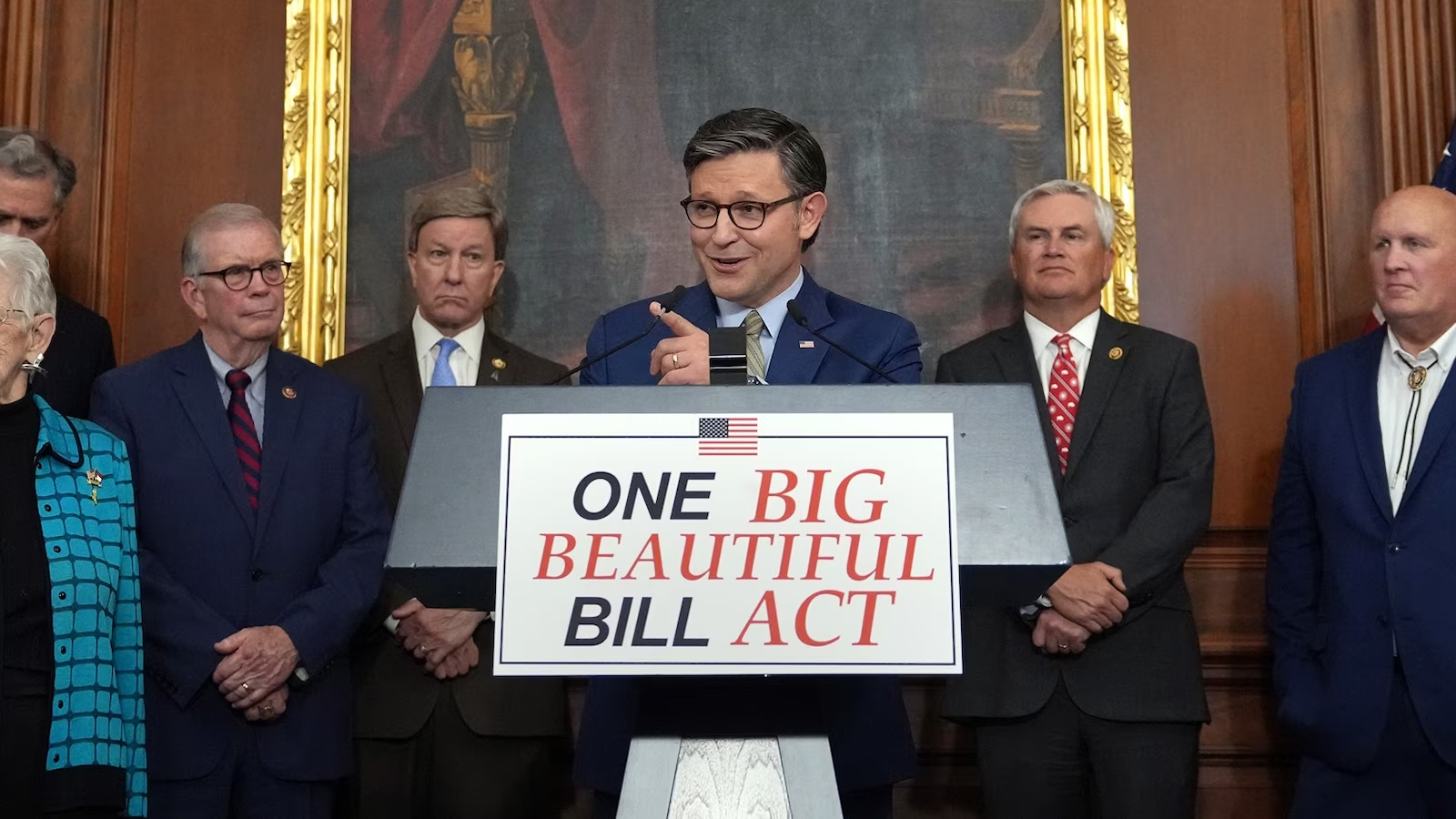
How Medicaid and SNAP work requirements in Trump’s “big beautiful bill” could affect older workers is becoming a pressing question as states begin to roll out major changes tied to the new law. For many Americans nearing retirement age, these policy shifts could influence not just access to benefits, but also when — or whether — they can afford to stop working.
President Donald Trump’s so-called “big beautiful bill” introduces new work requirements for both Medicaid and the Supplemental Nutrition Assistance Program (SNAP). Together, these changes may push some older adults to remain in the workforce longer than planned in order to keep health coverage or food assistance.
New Work Requirements and Who They Affect
Under the law, Medicaid work requirements now apply to certain adults up to age 64. States have until Jan. 1, 2027, to put those rules in place. At the same time, the legislation raises the SNAP work requirement age range to include people between 55 and 64 — an expansion from previous rules.
While some individuals may qualify for exemptions, they must be able to document that eligibility. Experts warn that as these rules are implemented, many older adults could feel forced to delay retirement simply to maintain access to essential benefits.
This pressure is especially acute for people who need health insurance but are not yet eligible for Medicare, which generally begins at age 65, or for those who rely on food assistance to make ends meet.
A Growing Divide Between Higher- and Lower-Income Workers
Higher-income older adults often have the option to work longer, enjoy better health, and live longer lives, said Jack Smalligan, a senior policy fellow at the Urban Institute. But the reality looks very different for lower-income workers approaching retirement age.
Many people who retire early do so because they are struggling physically or mentally to remain employed, Smalligan noted. With the new rules, those individuals may find themselves without food assistance or health coverage until they reach Medicare eligibility.
Including older adults in Medicaid work requirements also weakens the safety net at a time when affordability concerns are widespread and record numbers of Americans are reaching retirement age, experts say.
Budget Savings — and Human Costs
The Medicaid and SNAP changes are designed in part to help offset the cost of tax cuts included in the legislation. The Tax Foundation estimates that individual taxes could be reduced by $129 billion in 2025 alone.
At the same time, the Congressional Budget Office (CBO) projects that Medicaid spending will drop by more than $900 billion by 2034, with about $325 billion tied directly to work requirements. SNAP changes are expected to generate $186.7 billion in savings over the same period, with more than a third coming from stricter work rules.
Those savings, however, are likely to come at the expense of millions of Americans losing access to benefits — including a significant number of older adults.
How Medicaid Changes Could Impact Early Retirees
Before this law, federal rules generally prohibited Medicaid work requirements, although some states experimented with them independently. Under the new legislation, work requirements will apply in 43 states, particularly those that expanded Medicaid under the Affordable Care Act.
Adults ages 19 to 64 will generally need to work or participate in approved activities for at least 80 hours per month to qualify. Exemptions may apply to people with certain health conditions or parents of younger children, but the burden of proving eligibility remains.
The CBO estimates that these changes could leave an additional 5.3 million people uninsured.
Because the rules do not apply to people 65 and older, they may disproportionately affect those who retire early. Among Medicaid enrollees ages 50 to 64, about 11% are already retired, according to KFF, a nonpartisan health policy organization.
Experts expect some of these individuals to return to work simply to keep their coverage. Others, particularly those with health issues or caregiving responsibilities, may struggle with the administrative steps required to prove they qualify for an exemption.
Past experience highlights those challenges. When Arkansas implemented Medicaid work requirements in 2018 and 2019, nearly all affected enrollees technically met the rules or qualified for exemptions. Still, roughly one in four lost coverage — largely due to paperwork and reporting hurdles.
What SNAP Changes Mean for Older Americans
SNAP work requirements will now extend to able-bodied adults up to age 64 who do not live with dependent children. Under the new rules, individuals can receive SNAP benefits for only three months every three years unless they work at least 80 hours per month or qualify for an exemption.
The CBO estimates that about 2.4 million people could lose SNAP benefits in a typical month as a result.
For older workers, especially those in physically demanding or low-wage jobs, meeting these requirements may be difficult even if they do not technically qualify for a medical exemption. Administrative and emotional barriers can also play a role, experts say, particularly for people who are less comfortable with technology or feel stigma about seeking assistance.
Could Congress Revisit the Rules?
Much of the implementation will be handled at the state level, and timelines will vary. Still, policy experts note that large pieces of legislation are often followed by “cleanup” or corrections bills.
As the real-world impact of these Medicaid and SNAP work requirements becomes clearer, lawmakers could revisit parts of the policy. If evidence shows that the changes are pushing vulnerable older Americans off benefits unnecessarily, adjustments may follow.
For now, though, How Medicaid and SNAP work requirements in Trump’s “big beautiful bill” could affect older workers remains a critical issue — one that may shape retirement decisions for millions of Americans in the years ahead.