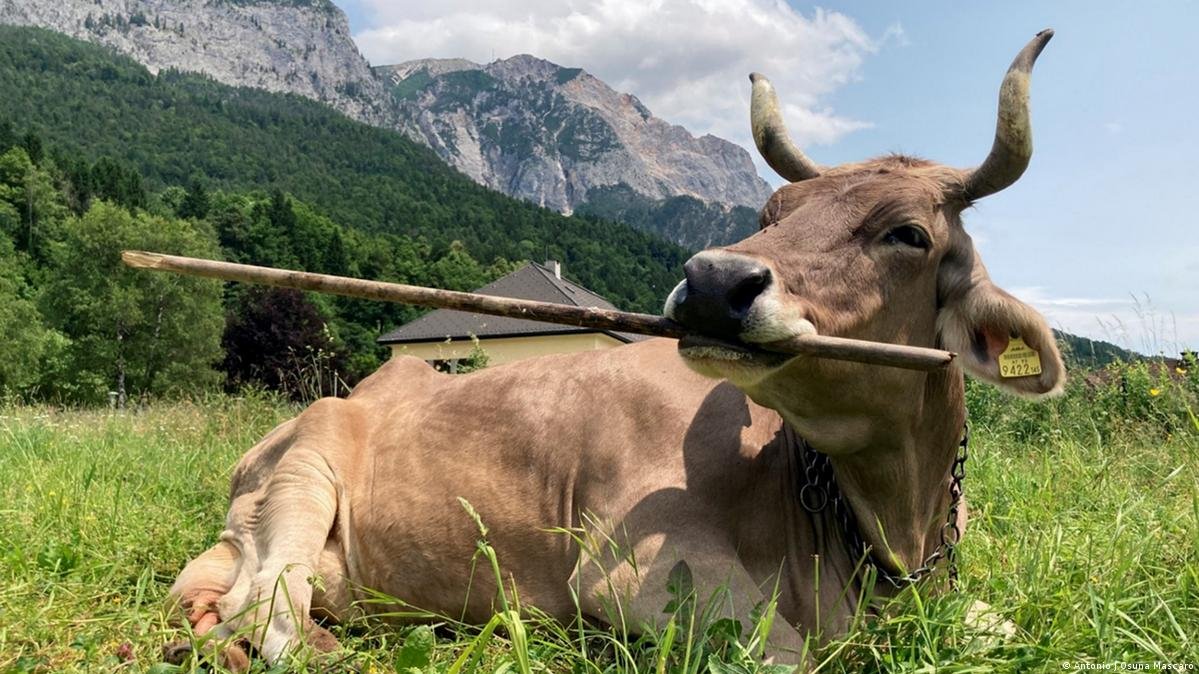
A surprisingly smart cow challenges what we think we know about bovine brains, and her name is Veronika.
A deck brush might seem like an ordinary cleaning tool, but in the hooves — or rather, the tongue — of Veronika, a Brown Swiss cow, it becomes something far more impressive. According to researchers, Veronika has learned how to use both ends of a deck brush to scratch different parts of her body, marking the first documented case of tool use in a cow. The findings were published on January 19 in Current Biology and are already pushing scientists to rethink long-held assumptions about cattle intelligence.
Cows are often dismissed as simple animals, but Veronika’s behavior tells a very different story. While most cows rely on trees, rocks, or wooden posts to relieve an itch, Veronika has figured out how to use a handheld object to reach spots that would otherwise be inaccessible. Antonio Osuna-Mascaró, a cognitive biologist at the Messerli Research Institute in Vienna, explains that the brush gives her a clear advantage: it allows her to target areas of her body she simply couldn’t scratch on her own.
What makes this discovery even more remarkable is how Veronika uses the brush. Living as a pet on a small Austrian farm, she carefully grips the handle with her tongue, then twists her neck to position the tool exactly where she needs it. When researchers placed the brush in different orientations, Veronika consistently chose the best end for the job. She used the stiff, bristled side on tougher areas like her back, while gently sliding the smooth handle over more sensitive spots such as her belly and udder.
At first, even the researchers doubted what they were seeing. Osuna-Mascaró admits he initially thought Veronika’s use of the handle was accidental. But after repeated observations, it became undeniable that she was intentionally using both ends of the brush in distinct ways, depending on the part of her body she wanted to scratch. This kind of flexible tool use — manipulating a single object for multiple purposes — has previously been observed consistently only in chimpanzees.
Animal behavior experts say the finding should make people reconsider how they view intelligence across species. Lindsay Matthews, an animal behaviorist at the University of Auckland who was not involved in the study, notes that humans are quick to praise animals like dolphins or primates for their intelligence, while overlooking farm animals. “Most animals are extremely clever if they’re given the right task to do,” he says. Matthews himself has even managed to potty-train cows.
One particularly smart detail caught his attention: instead of letting go of the brush and regripping it, Veronika sometimes simply turns her head in different directions to switch between the bristled end and the handle. Matthews describes this as an efficient strategy and suggests future experiments could explore how she interacts with other tools, such as brushes with bristles on both ends.
Still, scientists urge caution. Veronika is just one cow, and her abilities don’t necessarily represent the entire species. Alice Auersperg, another cognitive biologist at the Messerli Research Institute, points out that this behavior reflects problem-solving skills tied to a specific challenge, not proof that all cows are natural tool users. However, she emphasizes that Veronika’s lifestyle likely played a key role. Unlike cows raised in industrial farming systems, Veronika enjoys a calm, enriched environment that gives her the freedom to explore, experiment, and learn.
In the end, Veronika’s story is less about a brush and more about perspective. By showing curiosity, adaptability, and innovation, this single cow is reminding us that intelligence can appear in unexpected places — especially when animals are given the space to surprise us.