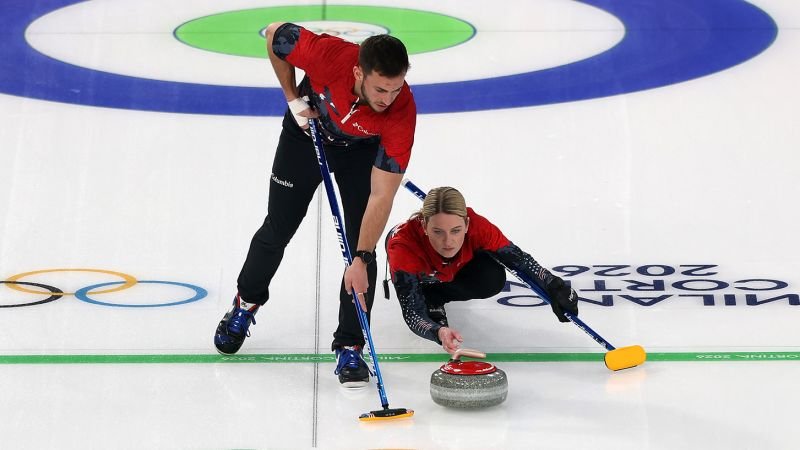
Team USA celebrated a historic moment on Tuesday, earning silver in mixed doubles curling after reaching the Olympic final for the first time. In the semifinal against Italy, American curler Cory Thiesse delivered a decisive shot that knocked the opposing stone out of position — a reminder that in curling, precision and equipment quality are equally critical.
But behind every winning shot lies a fascinating story about the stones themselves — and the extraordinary place they come from.
A Rare Island That Supplies the World
Professional curling stones are tightly regulated, weighing between 38 and 44 pounds (17–20 kilograms) and designed to last for decades. Most of the stones used in international competition — including all Olympic stones — are handcrafted by Kays of Scotland.
What makes them special is their source: a small, uninhabited island called Ailsa Craig, located off Scotland’s west coast. The granite found there is exceptionally fine-grained and tightly packed, giving the stones remarkable strength and durability. This dense structure allows them to withstand repeated collisions while maintaining a polished surface that glides smoothly across ice.
According to geological experts, the stone’s performance isn’t just about avoiding chips and cracks. Its internal structure also affects how it moves and rebounds during play. Other materials may slide adequately, but they don’t react the same way when stones collide — a difference elite curlers notice immediately.
Each year, Kays of Scotland produces roughly 2,000 to 2,500 stones for teams and facilities across more than 70 countries.
A Historic Sport Demands Precision
Curling has deep roots in Scotland, dating back to the 16th century when players slid stones across frozen ponds and lakes. The sport became an official medal event at the first Winter Olympics in 1924.
Today’s game is played on carefully prepared ice covered with tiny frozen droplets known as “pebbles.” These reduce friction and help the heavy stones glide. Players can also influence a stone’s path after release by sweeping the ice, slightly melting the surface to increase distance or adjust direction — making curling the only sport where the projectile’s movement can be altered mid-travel.
The ability of the stone to “curl,” or follow a curved path, comes partly from the natural characteristics of the granite itself, including the size and structure of its mineral grains.
A Geological Advantage Millions of Years in the Making
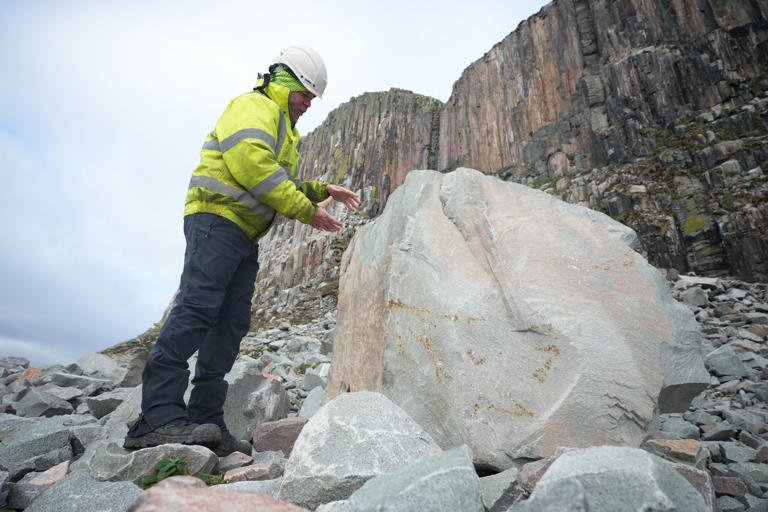
Ailsa Craig’s granite formed around 60 million years ago during a period of intense volcanic activity as the North Atlantic began to open. The resulting rock has unusual chemistry, including rare minerals rich in sodium and iron and unusually low aluminum content.
This unique composition gives the stone exceptional resistance to chipping and contributes to its consistent movement on ice. Scientists believe that the combination of rare minerals and tightly bonded crystals is what makes the material ideal — even if the exact reasons for its superior curling performance are still being studied.
Two Granites, One Perfect Stone
Three varieties of granite are found on Ailsa Craig, but two are used in modern curling stones:
Common Green Granite forms the main body and striking band — the area where stones collide. Its structure gives stones their slightly elastic, “springy” rebound.
Blue Hone Granite is used for the bottom running surface. Its low porosity prevents water absorption, helping the stone maintain its shape, texture, and performance over time.
Attempts to replace Ailsa Craig granite with synthetic materials such as ceramics have failed. While artificial surfaces may work initially, they wear down during play and lose the texture needed for consistent curling.
Tradition Meets Performance
Because of its unmatched qualities, Ailsa Craig granite has been the standard for competitive curling for nearly two centuries. The Royal Caledonian Curling Club required its use as early as 1838, and those standards carried into the Olympic Games when curling debuted in 1924.
Since then, no alternative has proven capable of matching its durability, consistency, and performance.
For athletes chasing Olympic medals, every detail matters — and in curling, success begins with a stone shaped by rare geology, centuries of tradition, and one remarkable island.