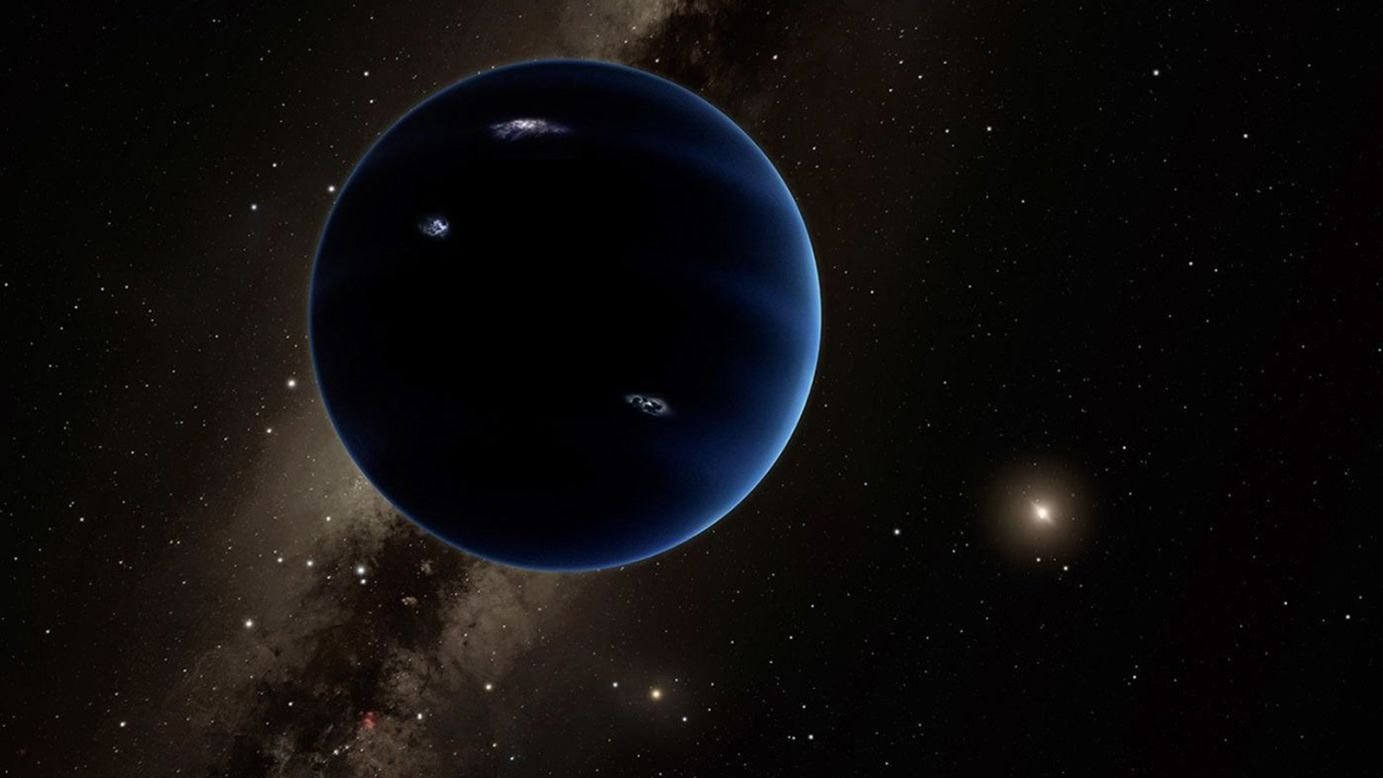
Astronomers have discovered a planetary system that they believe should not exist, and it may force scientists to rethink long-standing ideas about how worlds are born. Located about 116 light-years from Earth, the unusual system was identified using a combination of NASA and European Space Agency (ESA) telescopes, revealing a planetary arrangement that defies the traditional rules of planetary formation.
An Unusual Planetary Lineup
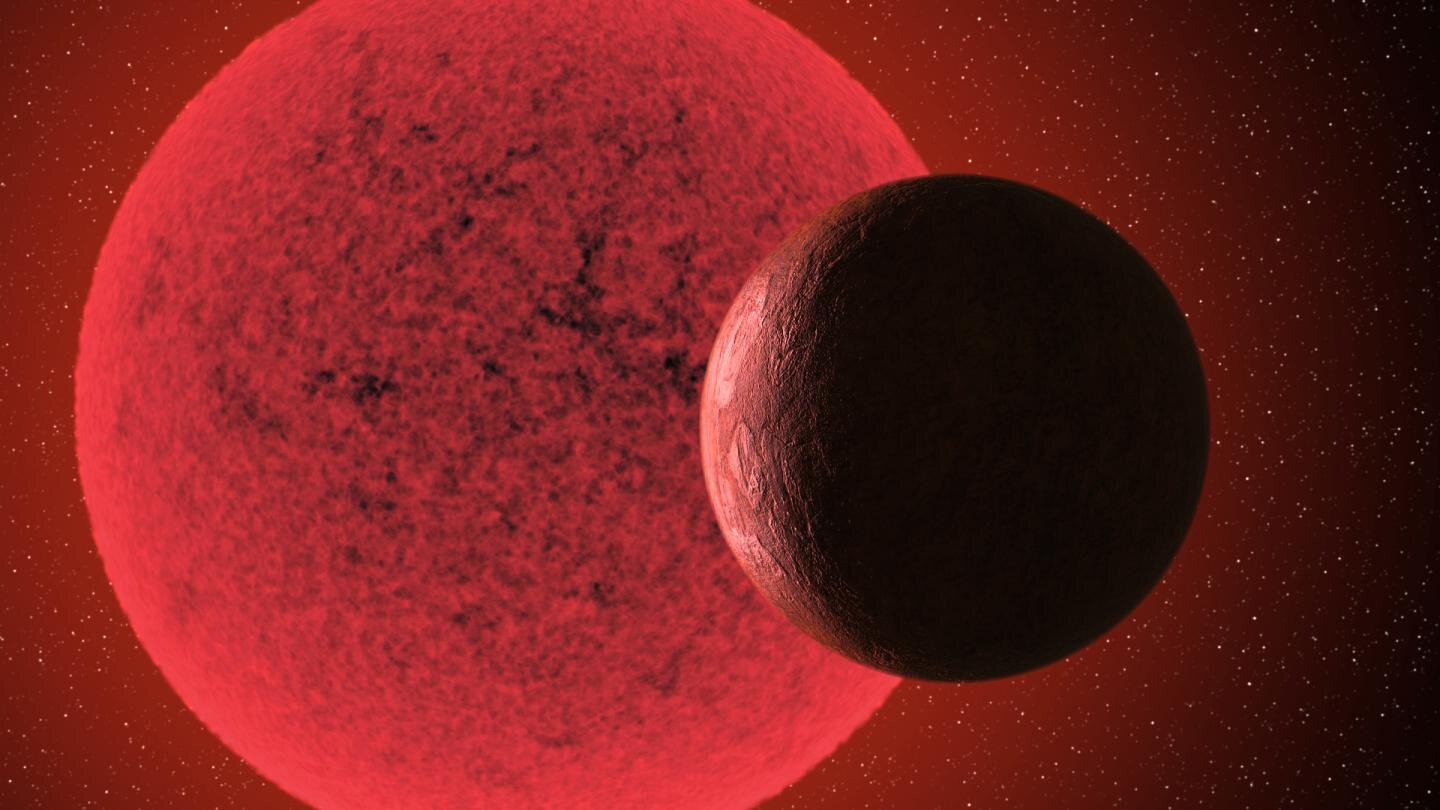
At the center of this strange system lies LHS 1903, a red dwarf — the most common type of star in the universe. Orbiting it are four planets arranged in an unexpected pattern. The planet closest to the star is rocky, followed by two gas-rich worlds. Surprisingly, the outermost planet is rocky again — a configuration rarely seen in planetary systems.

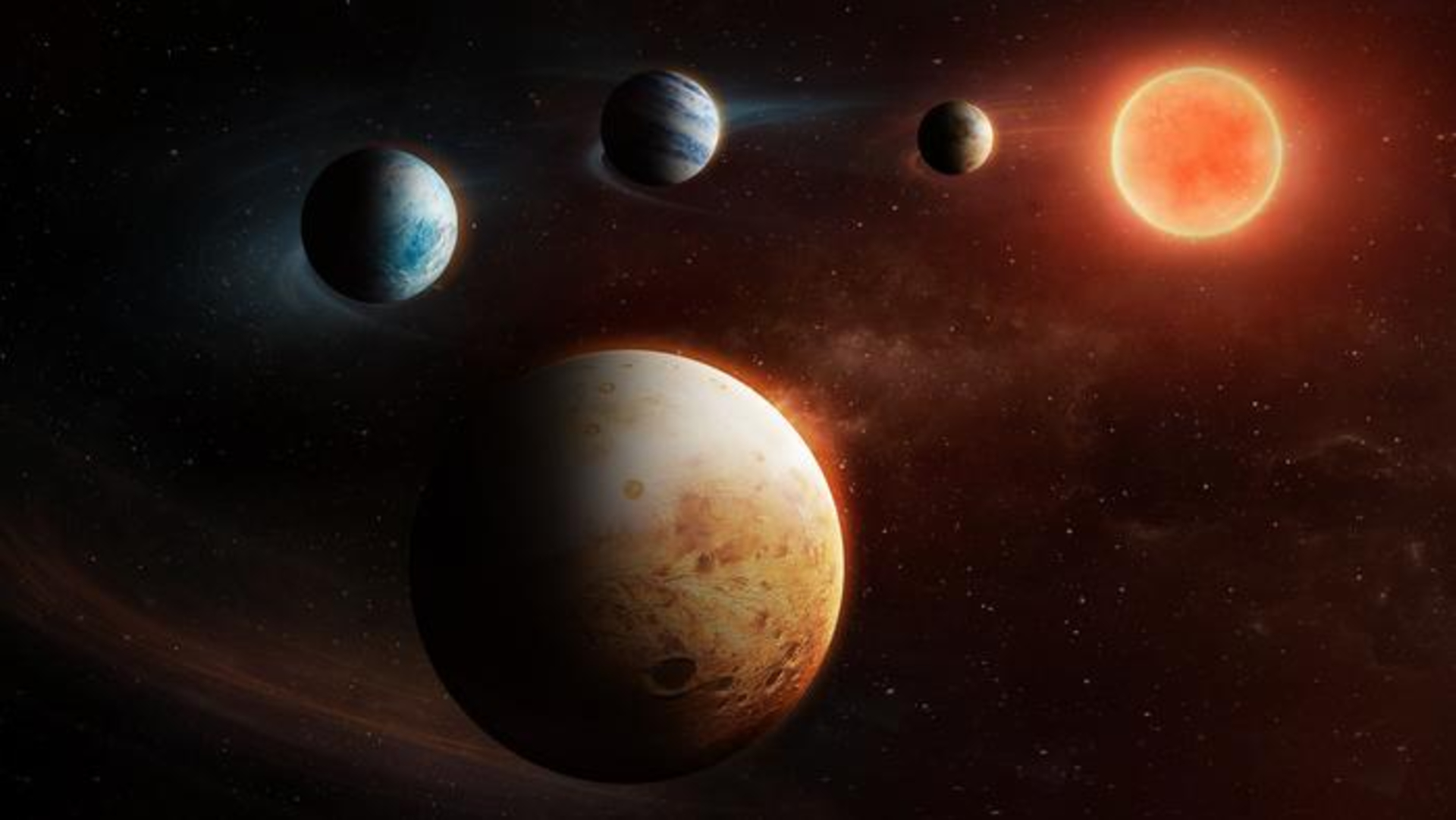
This structure contradicts the familiar pattern observed in our solar system, where small rocky planets orbit close to the Sun while massive gas giants remain farther away.
Why This System Breaks the Rules
Scientists believe planetary systems form within a disk of gas and dust surrounding young stars. Close to the star, intense heat allows only heavy materials like rock and metal to survive, leading to the formation of rocky planets. Farther out — beyond the so-called “snow line” — cooler temperatures allow ice to form, helping planetary cores grow large enough to capture thick atmospheres of hydrogen and helium. That process creates gas giants such as Jupiter and Saturn.
But in the LHS 1903 system, a large rocky world — named LHS 1903 e — sits beyond two gaseous planets. With a radius about 1.7 times that of Earth, it belongs to a class known as “super-Earths.” According to lead researcher Thomas Wilson of the University of Warwick, finding a rocky planet this far out — and beyond gas-rich neighbors — is highly unusual.
A Late Arrival: The “Gas-Depleted” Theory
The system was first spotted by NASA’s Transiting Exoplanet Survey Satellite (TESS) and later studied in detail using ESA’s CHEOPS mission along with data from ground-based observatories worldwide.
Researchers tested several possibilities to explain the odd arrangement. They explored whether the outer rocky planet might have formed from collisions or if it was once a gas giant that lost its atmosphere. However, simulations showed these scenarios were unlikely.
Instead, scientists propose a different explanation: a “gas-depleted” formation process. In this model, the planets formed sequentially from the inside outward. By the time the outermost planet began forming, most of the gas and dust in the disk had already dissipated. With little gas left to capture, the planet remained rocky rather than becoming a gas giant.
This means the outer world likely formed millions of years after the inner planets — the opposite sequence of what happened in our own solar system.
What This Discovery Means for Astronomy
The finding could represent early evidence that planet formation around red dwarf stars can follow very different paths. However, researchers emphasize that the interpretation is still under discussion. Planet formation remains a complex process, and scientists are cautious about drawing firm conclusions from a single system.
The outer planet is especially intriguing because its temperature may allow water to condense, making it an exciting target for future observations. Instruments such as the James Webb Space Telescope could study its atmosphere and reveal more about its composition.
A New Piece in a Bigger Puzzle
Astronomers say the LHS 1903 system could act as a natural laboratory for understanding how small planets form around stars unlike our Sun. Each new observation will help refine existing models and test competing theories.
While debates continue, one thing is clear: discoveries like this remind scientists that the universe still holds many surprises. Systems like LHS 1903 may ultimately reshape our understanding of how planetary families — including our own — come into existence.