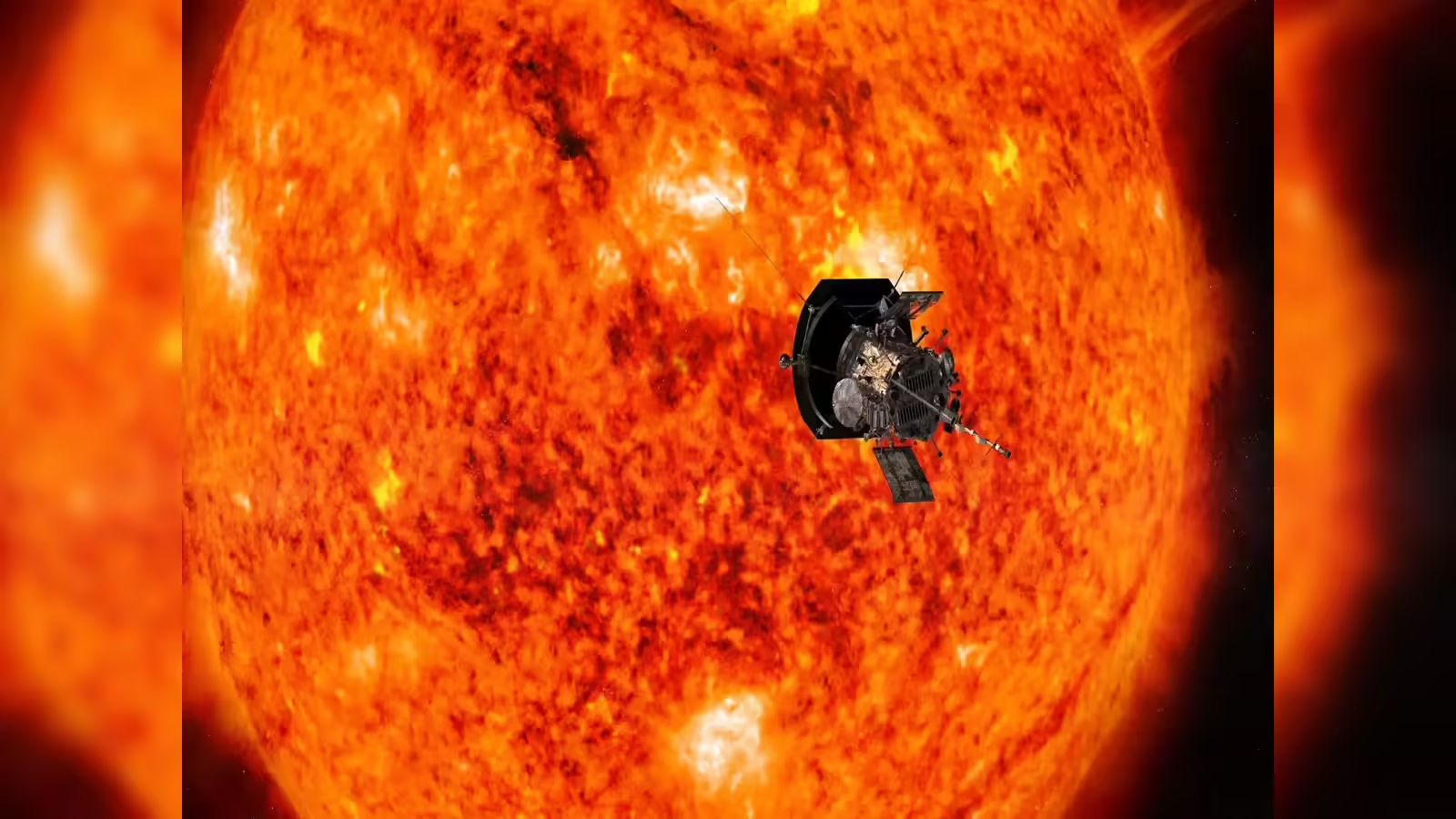
For more than a century, scientists have measured powerful solar storms against one historic benchmark: the Carrington Event. Yet while the phenomenon was widely known, the man behind it remained largely faceless. Now, researchers have finally uncovered a long-lost portrait of 19th-century British astronomer Richard Carrington, giving a human identity to one of the most important figures in solar science.
The Storm That Changed Science
On September 1, 1859, Earth was struck by the most intense geomagnetic storm ever recorded. Telegraph systems around the world malfunctioned as electric currents surged through their wires. Operators received shocks, equipment sparked, and in some cases, telegraph messages were transmitted even after power sources were disconnected.
At the same time, dazzling auroras illuminated skies far beyond their usual polar regions, appearing as far south as Panama. Today, the event is recognized as the strongest disturbance of Earth’s magnetic field caused by solar activity.
At the time, however, the concept of “space weather” did not yet exist.
The day before the storm, Carrington had observed something extraordinary: a sudden, brilliant flash on the sun’s surface — the first solar flare ever recorded. Using a telescope to project the sun’s image onto a screen, he documented the event and later connected it to the powerful geomagnetic storm that reached Earth just 17 hours later.
That insight laid the foundation for an entirely new scientific field. As modern researchers note, he experienced the sun’s power in a way no one had ever seen before or after — and now, his first portrait has finally been discovered.
A Scientist Without a Face
Despite his groundbreaking contributions, Carrington never became a widely recognized figure. One reason, historians believe, was the absence of any confirmed photograph.
The mystery caught the attention of Kate Bond, an assistant archivist at the Royal Astronomical Society in London. While the society preserved Carrington’s original sunspot observations from 1853 to 1861 — including his famous flare drawing — no image of him existed in their records.
Her search was inspired by earlier research and references that hinted a portrait might once have existed. Online searches only produced a mistaken image of another scientist, Lord Kelvin. Determined to solve the mystery, Bond began tracing historical photography records from the era.
An Unlikely Discovery
Carrington had been a member of the Literary and Scientific Portrait Club, whose members were photographed at a London studio between 1854 and 1865. Yet exhaustive searches across major museums and archives turned up nothing.
Then came a surprising breakthrough.
While browsing auction listings, Bond found a collection of 19th-century studio photographs for sale online. One image was labeled simply “Photo of Mr Carrington,” with a handwritten note reading “the late Carrington.”
The portrait showed a young man around 30 years old — Carrington’s age in the mid-1850s. After careful analysis, including examination of faint inscriptions revealed under special lighting, experts confirmed the subject’s identity. The writing referenced Carrington by name and linked the photograph to a colleague and friend, providing the final piece of evidence.
Today, the image has been added to the Royal Astronomical Society’s archives, where it now accompanies his scientific legacy.
A New View of the Sun — and the Scientist
Carrington’s achievements extended far beyond the famous storm. Over nearly a decade, he mapped sunspots, studied their motion, and discovered that the sun rotates at different speeds depending on latitude — early evidence that it is composed of flowing plasma rather than solid material.
He also contributed to stellar catalogs and helped advance understanding of the sun’s 11-year activity cycle.
Modern scientists estimate that a storm as powerful as the Carrington Event may occur only once every 500 years, while smaller but still significant events happen more frequently. Yet many aspects of solar flares remain mysterious even today.
The rediscovered portrait offers more than historical closure. It reminds us that science is driven by individuals — curious, observant, and persistent — whose work shapes our understanding of the universe.
After more than 150 years, Richard Carrington is no longer just a name attached to a historic solar storm. We can finally see the face of the man who first revealed the sun’s explosive power.